Core Principles of Synchronized Hydraulic Lifting
A synchronized hydraulic lifting system is an engineered solution designed to raise or lower heavy loads with exceptional precision and stability. Unlike standard hydraulic setups where individual cylinders may operate independently, a synchronous system ensures that multiple actuators move in perfect unison. This coordination is critical when handling uneven loads, large structures, or sensitive equipment where even millimeter-level discrepancies can lead to structural stress, instability, or failure.
The fundamental challenge in multi-point lifting is maintaining equal force distribution and positional accuracy across all lift points. A well-designed hydraulic synchronous system addresses this by integrating advanced control mechanisms—whether mechanical, hydraulic, or electronic—to monitor and adjust cylinder extension in real time. This capability transforms simple lifting into a controlled, predictable process essential for modern industrial operations.
Key Components and System Architecture
Understanding the architecture of a hydraulic lifting system reveals why synchronization is both complex and crucial. The system comprises several interdependent components that must work harmoniously:
- Hydraulic Cylinders: The primary actuators that convert fluid pressure into linear motion. In synchronized setups, cylinders are typically matched for bore size, stroke length, and seal quality to minimize inherent variations.
- Control Valves: Proportional or servo valves regulate flow rates to each cylinder with high precision. These valves respond to electronic signals, enabling micro-adjustments that maintain synchronization.
- Sensors and Feedback Devices: Linear displacement transducers (LDTs) or encoders monitor cylinder position continuously. Pressure sensors track load distribution, providing data for closed-loop control systems.
- Central Controller: A programmable logic controller (PLC) or dedicated synchronization module processes sensor data and adjusts valve positions dynamically. Modern systems use algorithms that compensate for load shifts, temperature changes, and fluid compressibility.
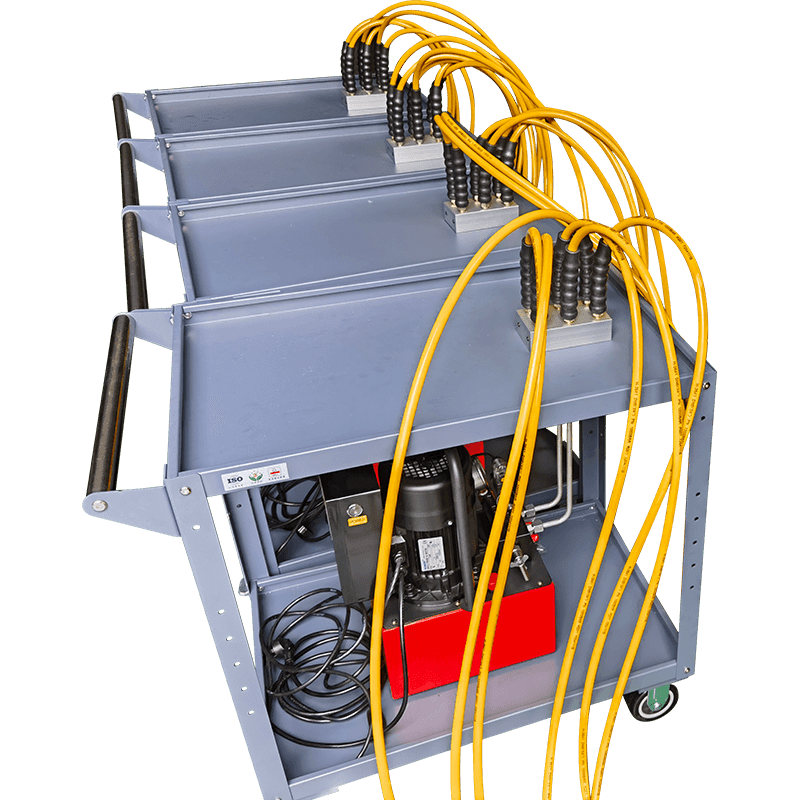
- Hydraulic Power Unit (HPU): Supplies pressurized fluid to the system. Variable-speed pumps improve energy efficiency and allow finer control over lifting speed.
The integration of these components determines system performance. For instance, a synchronous pushing system used in bridge launching may employ up to 16 cylinders, each monitored by independent sensors, with a central controller updating valve positions every 10 milliseconds to maintain synchronization within ±0.5 mm.
Synchronization Methods Compared
Not all synchronized systems achieve precision through the same means. Three primary methods dominate the industry, each with distinct advantages and limitations:
| Method |
Accuracy |
Complexity |
Best For |
| Mechanical Linkage |
±2-5 mm |
Low |
Simple, low-cost applications with moderate precision needs |
| Flow Division (Hydraulic) |
±1-3 mm |
Medium |
Systems with consistent loads and minimal external disturbances |
| Electronic Closed-Loop |
±0.1-0.5 mm |
High |
Critical lifts, uneven loads, and high-precision industrial tasks |
Comparison of synchronization methods for hydraulic lifting systems
Electronic closed-loop systems represent the gold standard for demanding applications. By continuously comparing actual cylinder positions against target values, the controller makes real-time corrections. This method compensates for factors like fluid leakage, temperature-induced viscosity changes, and asymmetric loading—issues that mechanical or purely hydraulic systems cannot address dynamically.
Industrial Applications and Case Studies
The versatility of synchronized hydraulic lifting systems has led to widespread adoption across industries where precision and safety are paramount.
Bridge Construction and Launching
In bridge launching operations, segments weighing hundreds of tons must be pushed forward simultaneously from multiple points. A synchronous pushing system ensures that differential movement does not induce bending stresses that could crack concrete or distort steel girders. For example, during the construction of the Millau Viaduct in France, synchronized hydraulic jacks maintained alignment within ±1 mm across 12 push points while advancing 36,000-ton deck sections.
Heavy Equipment Installation
Installing large turbines, generators, or industrial presses requires lifting objects with irregular weight distributions. Synchronized systems prevent tilting by adjusting individual cylinder forces based on real-time load cell data. In one documented case, a 450-ton generator was lifted using eight synchronized cylinders, achieving level positioning with less than 0.3 mm deviation across all corners.
Shipbuilding and Dry Dock Operations
Marine syncrolifts use arrays of hydraulic cylinders to raise vessels out of water for maintenance. Synchronization prevents hull distortion by ensuring uniform lift rates. Modern installations feature 20-40 synchronized lift points, with controllers adjusting for wave action and uneven weight distribution from fuel or cargo remnants.
Mining and Tunneling
Shield tunneling machines rely on synchronized hydraulic thrust systems to advance through soil or rock. Uneven thrust can cause the shield to deviate from its intended path, leading to costly corrections. Advanced systems maintain thrust synchronization within ±2% across dozens of jacks, ensuring straight tunnel boring even in heterogeneous ground conditions.
Benefits of Synchronization Over Conventional Systems
Investing in a hydraulic synchronous system delivers measurable advantages that justify the higher initial cost compared to non-synchronized alternatives:
- Enhanced Safety: Prevents catastrophic failures caused by uneven loading. Studies show that synchronized systems reduce lift-related accidents by up to 70% in heavy industrial settings.
- Structural Integrity Protection: Eliminates bending moments and torsional stresses that occur when lift points move asynchronously. This is critical for fragile or precision-machined components.
- Operational Efficiency: Reduces setup time and manual adjustments. Automated synchronization allows single-operator control of complex multi-point lifts, cutting labor costs by 30-50%.
- Precision Repeatability: Enables exact positioning for assembly operations. In aerospace manufacturing, synchronized lifts position aircraft fuselage sections with ±0.2 mm accuracy, reducing fit-up time and rework.
- Data Logging and Diagnostics: Modern systems record lift parameters for compliance documentation and predictive maintenance. Abnormal pressure spikes or position deviations trigger alerts before failures occur.
Design Considerations and Best Practices
Implementing a successful hydraulic lifting system requires careful attention to engineering details. Key considerations include:
- Load Analysis: Calculate center of gravity and weight distribution accurately. Use finite element analysis (FEA) for complex structures to identify potential stress concentrations during lifting.
- Cylinder Selection: Choose cylinders with adequate safety factors (typically 2:1 or higher). Match cylinder specifications to minimize inherent differences in friction and leakage rates.
- Control System Redundancy: Implement backup sensors and fail-safe valves. Critical applications should have dual PLCs or emergency manual override capabilities.
- Fluid Quality Management: Maintain ISO cleanliness codes (e.g., ISO 4406 18/16/13) to prevent valve clogging and sensor malfunction. Use temperature-controlled reservoirs for consistent viscosity.
- Commissioning and Testing: Perform unloaded synchronization tests followed by gradual load increases. Verify system response to simulated faults such as sensor failure or sudden load shifts.
Regular maintenance schedules should include calibration of position sensors, inspection of hydraulic hoses for wear, and validation of control algorithms. Documented maintenance records extend system lifespan and ensure continued synchronization accuracy.
Future Trends in Synchronous Hydraulic Technology
The evolution of synchronized hydraulic lifting systems continues driven by advances in automation, connectivity, and materials science:
IoT Integration: Cloud-connected systems enable remote monitoring and predictive analytics. Operators can receive real-time alerts on smartphones, while manufacturers analyze aggregated data to improve future designs.
AI-Enhanced Control: Machine learning algorithms adapt synchronization parameters based on historical performance data. These systems learn to anticipate load shifts and pre-adjust cylinder movements, improving response times by up to 40%.
Energy Recovery Systems: Regenerative hydraulic circuits capture energy during lowering phases, reducing power consumption by 20-35%. This sustainability focus aligns with industrial decarbonization goals.
Compact Electro-Hydraulic Actuators: Integrated pump-valve-cylinder units reduce plumbing complexity and installation space. These modular designs simplify maintenance and enable scalable configurations for varying lift requirements.
As industries demand greater precision and efficiency, synchronized hydraulic systems will remain indispensable tools for safe, controlled heavy lifting. Their ability to transform chaotic multi-point forces into coordinated, predictable motion makes them foundational technology for modern infrastructure development and industrial manufacturing.
 English
 عربى

 Custom Hydraulic Tools and Machinery Manufacturers